

Introduction
Buying a house, apartment, or plot is a major financial decision. However, a property that looks perfect may still have ownership disputes, incomplete documents, unpaid dues, or restrictions on its transfer. Therefore, buyers should verify every important document before paying a token amount or signing a sale agreement.
How to Verify Property Documents Before Buying a Property in Karachi is an important question for anyone planning to invest in Karachi’s real estate market. A careful review of ownership records, registered deeds, property approvals, and outstanding liabilities can help identify potential risks before the transaction proceeds.
The property verification process in Karachi depends on the property’s location, ownership history, and the authority responsible for maintaining its records. Consequently, buyers should not rely only on photocopies, an estate agent’s assurances, or a seller’s verbal promises.
Why Is Property Document Verification Important?
Property document verification helps establish whether the seller has a legally supportable right to transfer the property. It can also reveal inconsistencies in ownership records, unauthorized construction, competing claims, or financial liabilities.
For example, a seller may show an allotment letter for a plot. However, the buyer should also determine whether the allotment remains valid, whether the seller can transfer it, and whether the relevant authority has recorded any restrictions.
Similarly, an apartment may have a registered sale deed, but the building could have unresolved approval or lease issues. Therefore, buyers should examine both ownership documents and the property’s legal status.
How to Verify Property Documents Before Buying a Property in Karachi
Follow these practical steps before committing to a property purchase.
1. Verify the Seller’s Identity and Ownership
First, ask the seller to provide their original Computerized National Identity Card (CNIC) and the available ownership documents. Check that the seller’s name and identifying details match the records.
Next, determine how the seller acquired the property. The supporting document may be a registered sale deed, conveyance deed, allotment letter, lease, inheritance document, or another instrument relevant to the property’s legal status.
If someone is selling on behalf of the owner, examine the power of attorney and confirm its validity, scope, and continued effectiveness. Where necessary, verify the owner’s consent directly.
Important: Possessing an original-looking document does not automatically establish valid ownership. The document must also be checked against the relevant official record.
2. Check Property Ownership Records in Karachi
Property ownership verification in Karachi requires identifying the authority that maintains the property’s record.
The Sindh Board of Revenue provides the Sindh Zameen portal for searches of certain land records, property registers, maps, and registration information. Its online services cover specific record types and locations.
However, not every Karachi property appears in the same database. For example, the portal explains that land-owning agencies such as KDA and KMC maintain separate records.
Therefore, identify the property’s relevant land-owning or managing authority before starting the verification process. Obtain certified records from the appropriate office when required.
3. Verify the Property Registry and Title Documents
Property registry verification in Karachi involves examining the registered deed and the documents supporting the seller’s title.
Request the relevant registration details and verify them with the appropriate Sub-Registrar or registration office. Check the document number, registration date, parties’ names, property description, and other identifying information.
Moreover, compare the deed with the available allotment, lease, transfer, or mutation records. The plot number, survey number, area, boundaries, and ownership details should be consistent wherever applicable.
If the seller acquired the property through several previous transactions, a lawyer should review the ownership chain. This review can help identify gaps, conflicting transfers, or documents that require further confirmation.
4. Confirm the Property’s Location, Size, and Boundaries
Documents should describe the same property that the seller is offering for sale. Therefore, compare the recorded plot or survey number, covered area, location, and boundaries with the physical property.
Where appropriate, request an official survey, site plan, or measurement from the relevant authority or a qualified professional.
Also, confirm that the seller is not offering a portion of a larger property without the necessary subdivision or transfer approvals.
This step is particularly important when buying vacant plots, inherited land, jointly owned property, or properties with unclear boundaries.
5. Check Allotment, Lease, and Building Approvals
Karachi properties can have different legal arrangements. For this reason, buyers should identify the applicable documents rather than assume every property needs the same paperwork.
For a plot or leasehold property, examine the allotment or lease documents and confirm whether the relevant authority permits the proposed transfer. Check outstanding charges, transfer restrictions, and any required permission or no-objection certificate.
For an apartment or constructed building, ask for the relevant approved building plan, completion or occupancy documentation where applicable, and evidence of the building’s approval status.
The Sindh Building Control Authority (SBCA) and the relevant land-owning authority may have separate responsibilities. Consequently, building approval alone does not establish ownership, and an ownership document alone does not prove that construction complies with applicable requirements.
6. Investigate Mortgages, Disputes, and Outstanding Dues
Before paying the full price, investigate whether the property has any mortgage, attachment, litigation, competing ownership claim, or restriction on transfer.
Ask the seller to disclose existing loans and obtain appropriate evidence of discharge where a mortgage has been repaid. Depending on the property and circumstances, further checks may be needed with the relevant bank, authority, court, or registration office.
In addition, request available property tax receipts, utility clearance information, maintenance statements, and relevant authority dues. Confirm which liabilities must be cleared before transfer.
Remember that a tax receipt or utility bill does not independently prove ownership. These records support other checks but cannot replace title verification.
7. Review Inherited Property and Power of Attorney Documents
Inherited properties and transactions involving representatives require additional care.
If the seller inherited the property, examine the applicable inheritance, succession, or transfer records. Confirm who holds an interest in the property and whether all necessary parties have consented to the transaction.
Likewise, if a representative signs through a power of attorney, check the document’s authenticity, scope, and current legal status. A lawyer can determine whether additional evidence or formalities are required for the proposed sale.
Do not proceed merely because one family member claims authority to sell the entire property.
8. Complete Legal Verification Before Payment
Once the documents appear consistent, arrange a legal review before making a substantial payment. A property lawyer can assess the title history, identify missing documents, and advise which official confirmations remain necessary.
Use a written sale agreement that clearly records the property description, purchase price, payment schedule, completion conditions, and the parties’ obligations.
Furthermore, make payments through traceable channels and retain signed receipts. Avoid handing over the full purchase price before completing the agreed verification and transfer requirements.
Property Documents Checklist Before Buying in Karachi
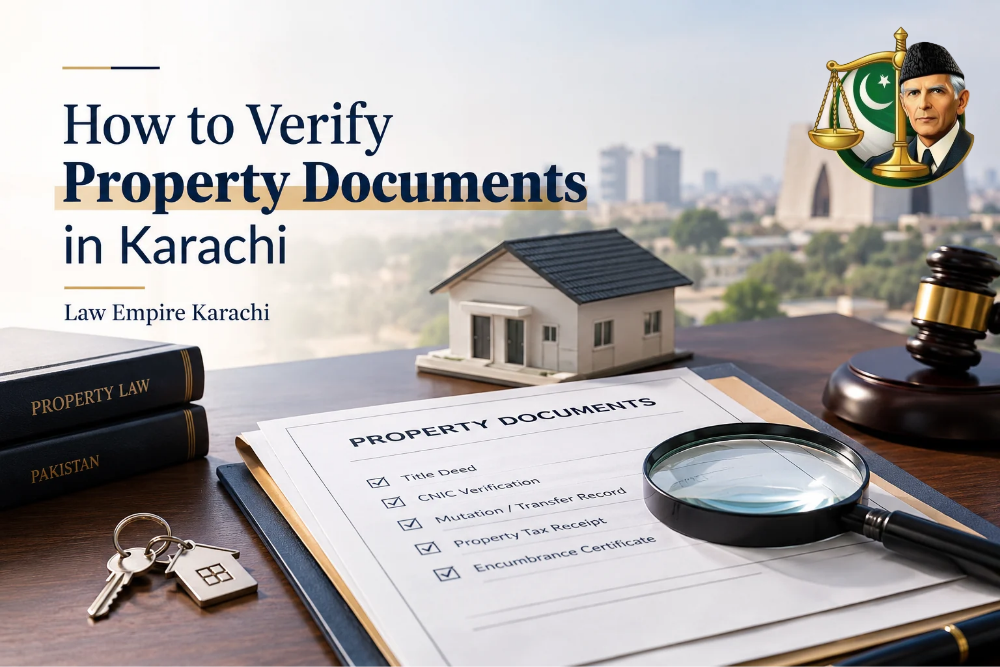
Use this checklist to organize the documents and checks relevant to your transaction:
- Seller’s original CNIC and identity verification.
- Original title document and available previous ownership records.
- Registered sale deed or conveyance deed, where applicable.
- Allotment, lease, transfer, or mutation records, as relevant.
- Official property register or land record confirmation.
- Approved building plan and relevant completion documents, where applicable.
- Mortgage discharge, NOC, or transfer permission, where required.
- Available property tax, utility, maintenance, and authority dues records.
- Inheritance or power of attorney documents, if applicable.
- Written sale agreement and a documented payment trail.
Not every document applies to every property. The correct checklist depends on the property’s legal category and the authority maintaining its records.
Common Warning Signs of Property Fraud in Karachi
Property fraud prevention in Karachi starts with recognizing warning signs before making payments.
Be cautious if the seller refuses to show original documents, pressures you to pay immediately, or provides inconsistent ownership information. Other warning signs include unexplained differences in plot numbers, missing transfer records, unclear powers of attorney, and promises that official approvals will be arranged after payment.
Additionally, treat unusually low prices and requests to pay an unrelated third party as reasons for further investigation.
If you discover a discrepancy, pause the transaction. Obtain independent verification and seek legal advice before proceeding.
Why Choose Law Empire Karachi?
Property transactions involve important legal and financial interests. Therefore, independent legal assistance can help buyers understand documents, identify potential title issues, and determine what further checks the transaction requires.
Law Empire Karachi provides a legal-services context for buyers seeking guidance on property-related concerns. Before completing a purchase, consider obtaining a professional review of the ownership chain, transfer documents, outstanding liabilities, and applicable legal requirements.
A legal review cannot guarantee that every future dispute will be avoided. However, it can help you make a more informed decision based on the available documents and verified records.
Conclusion
Understanding how to verify property documents before buying a property in Karachi can help you reduce avoidable risks and make a more informed investment decision.
Start by confirming the seller’s identity and ownership. Next, verify the relevant property registry, title history, approvals, and outstanding liabilities with the appropriate authorities. Finally, obtain legal advice before signing the final agreement or making substantial payments.
Most importantly, never rely on a single document or verbal assurance. Thorough property document verification in Karachi should combine official records, consistent paperwork, physical property checks, and an independent legal review.
For guidance on property-related legal concerns, consider contacting Law Empire Karachi.
Frequently Asked Questions
1. How can I verify property documents before buying a property in Karachi?
Start by checking the seller’s identity, title documents, ownership history, and relevant property registry. Then confirm the property’s status with the appropriate land-owning authority and investigate any mortgages, disputes, or outstanding dues. Finally, obtain a legal review before payment.
2. How can I check property ownership records in Karachi?
Identify the authority responsible for the property. The Sindh Board of Revenue’s Sindh Zameen portal provides access to certain land records and Karachi property registers. However, some properties fall under separate agencies, so you may need confirmation from the relevant authority.
3. What documents should I check before buying a property in Pakistan?
Depending on the property, check the title deed, registered sale deed, allotment or lease documents, transfer records, seller’s CNIC, relevant approvals, and evidence of outstanding dues. Inherited properties and transactions through representatives may require additional documents.
4. Is an allotment letter enough to prove property ownership?
Not necessarily. An allotment letter may establish an allocation or interest under a particular scheme, but it does not automatically prove unrestricted ownership or transfer rights. Verify the letter with the issuing authority and review the property’s complete legal history.
5. Can I verify a property online in Karachi?
Yes, certain land and property records are available through official online services. However, online information may be incomplete and may not have the legal status of a certified record. Obtain official confirmation from the relevant authority before completing a transaction.
6. How can I identify property fraud before buying a house in Karachi?
Look for inconsistent ownership documents, mismatched property details, missing transfer records, unclear authority to sell, and pressure to make immediate payments. Independently verify the documents and pause the transaction if any discrepancy remains unresolved.
7. Should I hire a property lawyer before buying a property in Karachi?
A property lawyer can review the title chain, registered documents, transfer restrictions, and potential disputes. Legal assistance is particularly useful for inherited property, disputed ownership, powers of attorney, and properties with incomplete records. A review reduces uncertainty but cannot guarantee a dispute-free purchase.
Contact Law Empire Karachi:
Email Address: info@lawempirekarachi.com
Phone/Whatsapp: +92 315 0122348
Office: F-20/2, Ground Floor, Gizri Road, P&T Colony, Block 9 P&T Colony, Karachi, 75600